

Online training - Call us on 1300 009 924
Online training - access your course anytime, anywhere! Call us on 1300 009 924
Technology

Certified Cyber Security Associate

T-CCAS
Next Intake
14 Sep 2026
100 Hours of Learning
100% Online, Self-Paced
3 Modules
60% Hands-On Labs
6 Months Access
Pay upfront & save
Mentor Support Available
TechDX Certification
No Experience Required
In partnership with

Course Overview

Start in cyber security, hands-on from day one

The Certified Cybersecurity Associate is one certification, sold on its own, and it is built to be your first step into cyber security. It covers 100 hours across three units, Foundations, Systems and Operations, moving from computing fundamentals and networking through system administration to cloud security, threat defence and AI-driven security operations. Entry asks for basic computer literacy and nothing more: you do not need cyber security experience to begin. Everything is fully online and self-paced inside TDX Arena, which runs in a browser, and 60% of your hours go into hands-on labs, with the rest in lessons. You finish with an applied, scenario-based exam and a TechDX certification. It is non-accredited training, not a nationally recognised qualification.

Starting with one certification keeps the commitment small. You are committing 100 hours, not a full pathway, which is enough time to work in labs, sit an applied exam and find out whether security work actually suits you before you spend more. Longer programs are worth doing when you already know you want the field. If you are still deciding, this gives you a real answer and a TechDX certification to put in front of an employer either way.

Who is this course for?

  • Complete beginners with no cyber security or IT background, starting from basic computer literacy.
  • Career changers who want a structured route into security rather than scattered self-teaching.
  • IT and helpdesk workers moving sideways into security who need a verifiable technical base.
  • People who want demonstrable, tested skills on real workflows instead of theory-only study.
  • Anyone studying around a job or family who needs self-paced access, not fixed classes.
  • Learners who want stackable credentials and solid ground before harder technical certifications.


Is this cyber security course accredited?

No. The Certified Cybersecurity Associate is non-accredited training. You earn a TechDX certification and three units, awarded by TechDX and recognised by industry. You do not receive a nationally recognised qualification under the Australian Qualifications Framework, it is not delivered under Upskilled's RTO scope, it is not a Statement of Attainment, and it does not licence you to perform a regulated role.

For most people starting out that is the right trade: it is faster, it is hands-on, and you can begin with no experience. If you specifically need nationally recognised training, for an employer requirement, a visa, a government role or a study pathway, Upskilled also delivers accredited IT qualifications. The ICT40120 Certificate IV in Information Technology (Focus on Cyber Security) is the closest accredited equivalent, and you can compare the full range of cyber security qualifications.

Cyber security skills you will walk away with

  • Work confidently at the command line on desktop and server systems without step by step instructions.
  • Read network traffic and system logs well enough to say what happened on a machine.
  • Harden a desktop or server build and explain each change you made to a manager.
  • Rank vulnerabilities by severity using CVE records and CVSS scores, then recommend what to patch first.
  • Triage an alert or suspicious email from first look to a written escalation decision.
  • Describe an incident using MITRE ATT&CK and the NIST Cybersecurity Framework in language colleagues understand.

The kind of work you will do in the labs

Your lab hours are spent inside genuine security tooling rather than reading about it. Which products you meet is set by the platform, so what follows describes the work itself and the public frameworks behind it.

  • Navigating and controlling systems from the command line
  • Inspecting network traffic to understand what is being sent
  • Reviewing logs and alerts to find activity worth investigating
  • Hardening endpoints through patching, configuration and account controls
  • Setting up cloud identity and access permissions safely
  • Examining suspicious emails for the signs of phishing
  • Scanning for known vulnerabilities and rating how serious they are

The TechDX course outline describes "real tools and real-world workflows" without naming specific software products, so this page describes the type of work rather than naming vendor tools.

Frameworks you will be introduced to

  • MITRE ATT&CK: A shared catalogue of attacker techniques, so you can name what you are seeing.
  • The cyber kill chain: Breaks an attack into stages, which helps you work out how far one got.
  • NIST Cybersecurity Framework: The common language for how organisations identify, protect, detect, respond and recover.
  • CVE and CVSS How software flaws are identified and scored, so you know which ones to fix first.
  • ASD Essential Eight: The Australian baseline controls you will be asked about in local security roles.

Course Modules

The certification is made up of three units, each with its own badge. Foundations covers how computers and networks actually work. Systems takes you into running and hardening those machines. Operations puts you in the seat of someone defending a live environment, including cloud, threat defence and AI-driven security work.

This is the ground floor: how a computer, an operating system and a network actually behave before anyone attacks them. You work at the command line to navigate a file system, read permissions, and check running processes. You build and trace a small network, follow a request from one machine to another, and open a recorded traffic sample to see what each protocol looks like on the wire. Labs cover IP addressing, ports, DNS, and the difference between encrypted and plaintext traffic, plus core ideas like confidentiality, integrity, and availability.

  • Navigate a file system from the command line
  • Read a traffic sample and identify protocols
  • Explain IP addressing, ports and DNS basics
  • Set file permissions and check running processes
  • Apply confidentiality, integrity and availability to scenarios

Here you take charge of the machines. You set up user accounts and groups, apply least privilege, and work out why a permission is blocking someone. You harden a desktop and a server by closing unused services, tightening remote access, patching known vulnerabilities and configuring a host firewall. You read system and application logs to reconstruct what a user or a process did. Vulnerability scanning introduces CVE records and CVSS scores so you can rank issues, and the ASD Essential Eight gives you a checklist Australian employers recognise.

  • Create user accounts and apply least privilege
  • Harden a desktop and server build
  • Close unused services and configure host firewalls
  • Rank vulnerabilities using CVE records and CVSS scores
  • Trace user activity through system logs

The third unit puts you on the defending side. You review alerts raised from collected log data, decide which ones matter and write up what you found. You pull apart a suspicious email, tracing its header trail, testing where links really go and deciding whether to escalate. You map attacker behaviour against MITRE ATT&CK and the cyber kill chain, and use the NIST Cybersecurity Framework to describe a response. Cloud labs cover identity, access keys and misconfigured storage, and you use AI-assisted analysis to speed up triage without taking its answer on trust.

  • Triage security alerts and escalate real incidents
  • Analyse a suspicious email end to end
  • Map attacker activity to MITRE ATT&CK
  • Review cloud identity and storage configuration
  • Use AI-assisted analysis to speed triage

How you will learn on the TDX Arena

Your study happens inside TDX Arena, the training environment TechDX built for this certification. Open a browser tab, and you are in the lab: lessons, practice, questions and your final exam all live behind the same login. The suggested rhythm is ten hours a week across ten weeks, inside 6 monhts of platform access.

A browser tab is the whole setup

Nothing gets downloaded and nothing gets built on your own machine. The environment loads in the browser you already use, so a standard laptop and a steady connection are enough to start your first lab.
Real tooling and labs that keep pace with you

You work with genuine industry tooling on the tasks security teams actually do. The AI reads your performance and shapes what follows, so weak spots get more repetition and skills you have already proven do not.
Sixty per cent of your time is spent doing

Of the 100 hours, 60 go to labs and 40 to lessons. A concept is explained, then you are put to work on it, which is a very different thing from watching a demonstration.
An exam you perform, not one you tick

The certification finishes with a scenario you have to handle. Marks come from the decisions you make and the steps you take inside it, so there is no question bank to memorise the night before.
Ember answers at any hour

Ember is the AI teaching assistant, reachable around the clock by avatar, voice or typed message. Hints are built into the labs as well, so being stuck on a weekend does not cost you a week.
One place to ask, one view of your progress

Whatever the question, technical or administrative, there is a single form, a single email address and a single phone number to use. Your completion tracks unit by unit, so you always know how much is left.

Career and Industry Outlook

Cyber security is one of the few technical fields where employers hire on demonstrated capability as much as on time served, which is what makes an applied, lab-based entry point worth doing. There are 13,300 ICT Security Specialists employed in Australia, and the work is overwhelmingly full time: 92% work full-time hours, against 64% across all occupations (Jobs and Skills Australia, ICT Security Specialists ANZSCO 262112, drawing on the ABS Labour Force Survey Detailed, February 2026, and the ABS 2021 Census).

The workload behind those roles is not theoretical. The Australian Signals Directorate received more than 84,700 cybercrime reports in a single year, an average of one every six minutes (ASD Annual Cyber Threat Report 2024-25). Advertised salaries for security analyst roles sit at roughly $103,000 to $115,000 (SEEK, July 2026), although those figures describe established practitioners rather than people entering the field.

This certification is a starting point, not a shortcut to those numbers. What it gives you is the technical vocabulary, a working base across networks, systems and operations, and a set of completed lab tasks you can talk through in an interview.

Roles this course can support

  • Cybersecurity Associate
  • Cybersecurity Intern
  • IT Support Officer with security duties
  • Service Desk Analyst
  • Junior Systems Administrator
  • Security Awareness Support

Cybersecurity Associate and Cybersecurity Intern are the roles TechDX aligns this certification to. The others are entry-level positions where these skills are useful, not roles this certification qualifies you for on its own. Salary and employment figures describe the wider security workforce, not outcomes for graduates of this course.

Career support that goes the distance

Your cyber security associate bootcamp is just the start. Our internship program can help you turn study into real work, real contacts and real outcomes.

Upskilled Internships

Turn your qualification into real Australian work experience. Complete 80% of your course and apply for a 12-week internship with a top host company, delivered with Career Success Australia. Past placements include NAB, BHP, PwC, Telstra and IBM.

Get in touch to know more.*

*Terms and conditions apply.
Industry Insights

Students who successfully complete this course may be on the path to pursuing a rewarding career incyber security.

Employed

29,100 Professionals

Currently working in cyber security roles, reflecting the growing importance and demand for cyber security expertise in Australia.
Weekly Earnings

$1,920 per week

Cyber security professionals average weekly incomes, providing financial stability and highlighting the value of cyber security skills in the job market.
Full-Time Share

91% Work Full-time

Indicating the industry's commitment to sustained and robust contributions from its workforce.
Female Share

21% of the Workforce

The cyber security sector has a lower representation of women; this underscores the need for greater gender diversity within the field.
Average Age

40 years

Showcasing a diverse age range and the maturity of the workforce in handling complex cyber security challenges.

Payment Options

Pay Upfront & Save
You pay $880
RRP $1300
Payment Plan - Weekly
Interest Free
Setup fee today. $300
25 Weekly Payments $40
Total you'll pay. $1,300

What is included

  • Lessons and course content. Lessons make up 40% of your 100 hours. They run as interactive digital media inside the TechDX learning system, with each idea explained before you practise it.
  • Hands-on labs with real tools. The other 60% is lab work. You practise on the categories of tooling security teams use daily, and the labs adjust as your skill grows.
  • Ember, the AI teaching assistant. Ember answers questions at any hour of the day by avatar, voice or text. In-platform hints also nudge you forward when a lab stalls.
  • Scenario-based and final exams. Scenario-based exams run inside the units as you go, then a hands-on certification exam at the end asks you to work a realistic security problem.
  • Progress tracking and platform support. A dashboard shows how much of each unit you have completed. Support sits in one place, whether your question is technical, administrative or about the content.
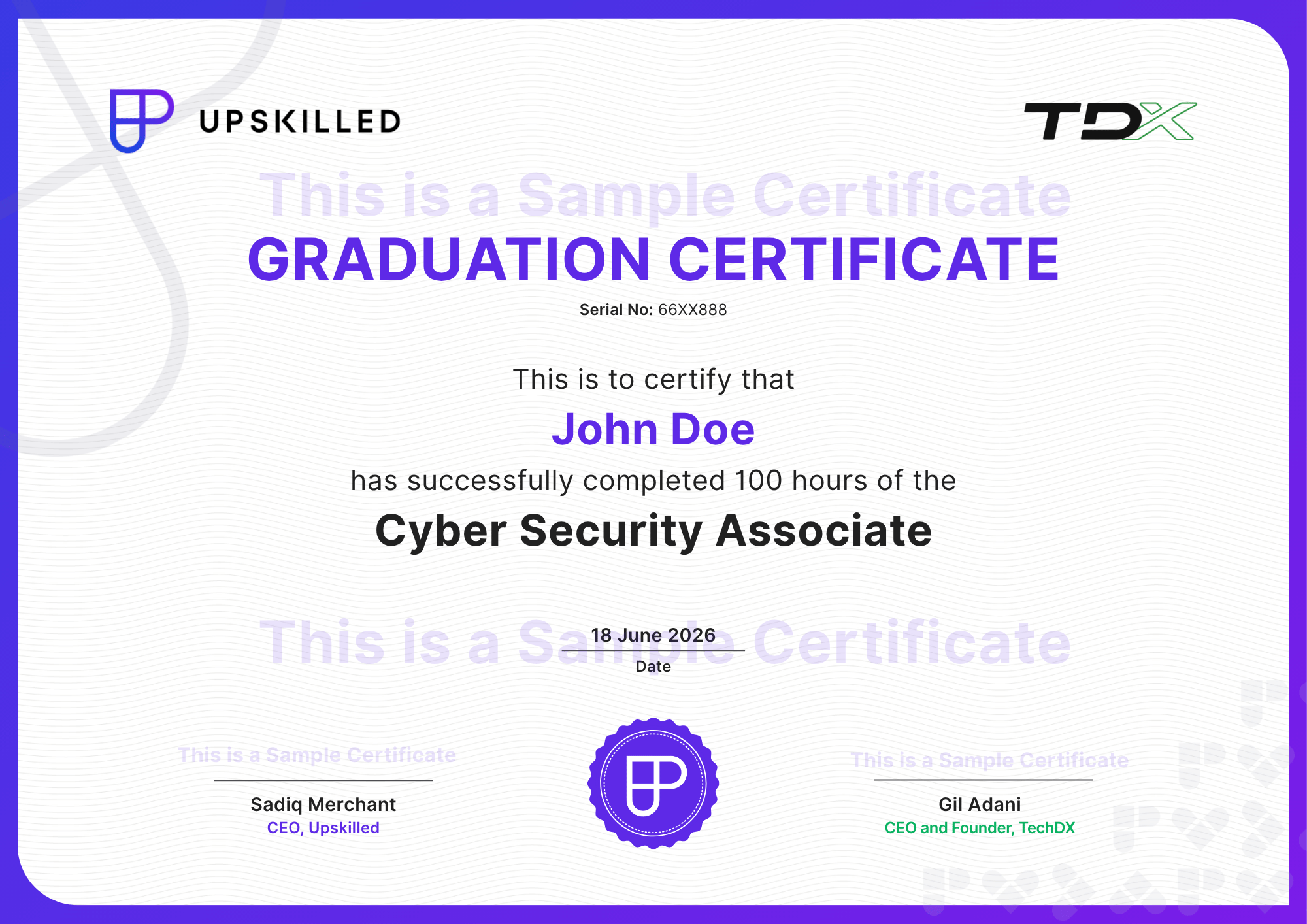
  • Your completion package. You finish with the TechDX certification, all three units completed, plus skills lists, case studies and an achievement report you can show employers.

Your Certified Cybersecurity Associate certification

Pass the final applied exam, and you receive the Certified Cybersecurity Associate certification from TechDX, along with credentials for all three units, a Skills List setting out what you can do, the case studies from the work you completed, and an Achievement Report. Together these give an employer something more specific than a course title on a resume: evidence of tasks you have actually performed in a lab environment.

Cyber-Associate-TechDX-Cert.png

This certification is issued by TechDX and recognises completion of applied assessment. It is not AQF or ASQA accreditation.

Certified Cybersecurity Associate course FAQs

It is a single entry-level cyber security certification from TechDX, delivered online by Upskilled on the TDX Arena platform. You cover 100 hours across three units, with 60% of that time spent in hands-on labs, and finish with an applied certification exam. It suits career changers, IT workers moving sideways into security, and anyone who wants one credential that shows they can do the work rather than just describe it.

No. It is non-accredited training. It is not an AQF qualification, it is not a Statement of Attainment, and it does not licence you to work in any regulated role. What you earn is an industry certification issued by TechDX, which sits alongside formal study rather than replacing it. If you need a nationally recognised credential, Upskilled also delivers nationally recognised IT qualifications, including a Certificate IV in Information Technology focused on cyber security, so check what the roles you are aiming at actually ask for.

No. Entry requires basic computer literacy and nothing else. No prior security study, no IT job, no coding and no formal qualification are needed. The first unit opens with computing fundamentals and networking, so terms like operating system, port and protocol are explained before you are asked to use them. If you can find your way around a computer and follow written instructions, you are ready to start.

Plan on about 10 weeks. The certification is 100 hours and the recommended pace is 10 hours a week for 10 weeks, though study is self-paced so you choose when those hours happen. Platform access runs for 6 months from enrolment, so there is room to pause and pick it back up without losing your place. Evenings and weekends are enough to keep the pace if your weeks are otherwise full.

Everything happens in your browser on TDX Arena, with 40% lessons and 60% labs. Lessons use interactive media, then labs put the same skill in front of you as a task to complete, with AI hints and the Ember teaching assistant available at any hour if you get stuck. Assessment is scenario-based throughout, and the certification exam at the end is hands-on, so you finish by solving a realistic security problem rather than answering questions about one.

TechDX aligns this certification to two entry-level roles: Cybersecurity Associate and Cybersecurity Intern. It is a starting credential, not a guarantee of work. You will still apply, interview and compete, and government and defence security work in Australia usually needs a formal qualification and a clearance an employer has to sponsor. What it gives you is documented, lab-tested skill to put on a CV when you have no security work history yet.

You receive the TechDX Certified Cybersecurity Associate certification, plus completion of all three units: Foundations, Systems and Operations. Alongside the certification, you get a skills list setting out what you can now do, the case studies you worked through, and an achievement report covering your progress and results. Those documents are useful in interviews, because they let you talk about specific tasks you completed rather than topics you covered.

TechDX continues into three further certifications: Cybersecurity Analyst, then SOC Analyst, then CTI Analyst, each another 100 hours on the same platform. You can take them one at a time as you decide how far you want to go. If you already know you want the whole pathway, Upskilled sells all four together in one enrolment as the Cyber Security Online Bootcamp. Finishing here and stopping is a perfectly reasonable choice too.